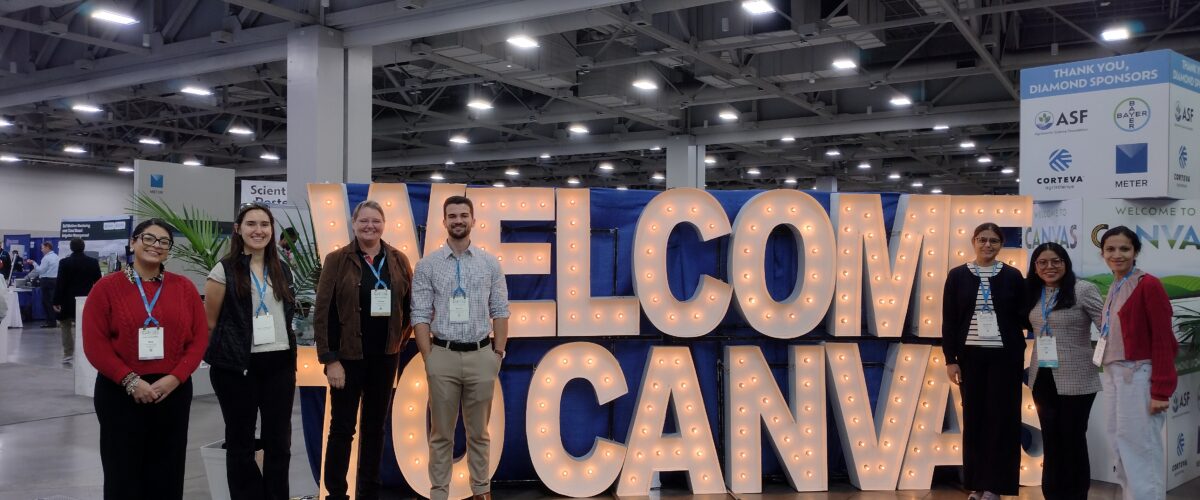
Research from the Dairy Soil and Water Regeneration (DSWR) project was on display when agronomy, crop and soil professionals from around the world gathered Nov. 9-12 for CANVAS 2025 in Salt Lake City, Utah, where they discussed ideas and innovation from across the field of environmental sciences.
The American Society of Agronomy, the Crop Science Society of America, and the Soil Science Society of America jointly host the event (formerly the ASA, CSSA, SSSA International Annual Meeting) for emerging learners and leaders from industry, government agencies and academic institutions to explore scientific advances.
Several DSWR project team members gave presentations related to the project:
 Dr. Asmita Gautam, postdoctoral research associate at Cornell University, shared insights from a field trial on a farm in New York that studied the effects of reduced tillage, cover cropping and manure-based products, including novel evaporative and flocculated solids, on greenhouse gas emissions and corn silage yield.
- Sara Mach Tomas, a Cornell research intern, reviewed assessments of soil microbial health on a dairy, comparing the conventional field practices of full-width tillage, liquid dairy manure and broadcasted wheat as a cover crop versus the soil health management practices of reduced tillage, composted dairy solids and drilling of cereal rye as a cover crop.
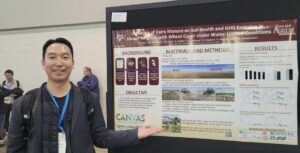 Dr. Myeongseong Lee, a postdoctoral research associate at Texas A&M AgriLife Research and Extension, presented his team’s study that evaluated the effects of tillage and nutrient amendments, including evaporative solids, on soil fertility, soil health and greenhouse gas emissions in a forage sorghum-wheat cover crop in limited irrigation in the Southern Texas High Plains.
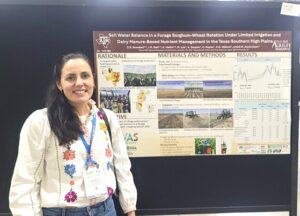 Dr. Carolina Brandani, a Texas A&M AgriLife Research and Extension assistant professor, shared information from a study that assessed two-year water balance dynamics in a forage sorghum-wheat rotation under various tillage and manure-based nutrient management systems in Bushland, Texas, located in the Southern Texas High Plains.
- Dr. Dan Liptzin, research scientist and program director at the Soil Health Institute, provided findings from the use of published data on feed rations and cow populations to estimate the land area needed to support the dairy industry in major dairy regions of the U.S.
- Dr. Jerry Chen-Hsiao, a research soil scientist with the Soil Health Institute, evaluated the living root index and general tillage intensity ratio using management records and soil data from dairy fields in New York and two Wisconsin regions to improve how the effects of soil health management practices are measured.
Victor Green, director for soil health and crop sustainability at Dairy Management Inc., which initiated DSWR, said that sharing research results is a vital component of the project.
“One of the major objectives of the DSWR project is to present findings to the scientific community,” said Green, who attended CANVAS 2025. “The conference offers a great opportunity to present research data, but more importantly, to interact personally with scientific and research colleagues from around the world.”
The Foundation for Food & Agriculture Research (FFAR), a major supporter of DSWR, held a grantees and partners reception focused on scientific knowledge exchange and community building. The event included a Sustaining Vibrant Agroecosystems Priority Area, a space where participants shared key findings, wins, challenges and lessons from FFAR-funded research programs. Attendees had the opportunity to network, explore synergies and foster collaborations that strengthen agroecosystem resilience through integrative research.
A brief program at the reception highlighted current FFAR agroecosystem research priorities, upcoming opportunities and emerging areas of interest.