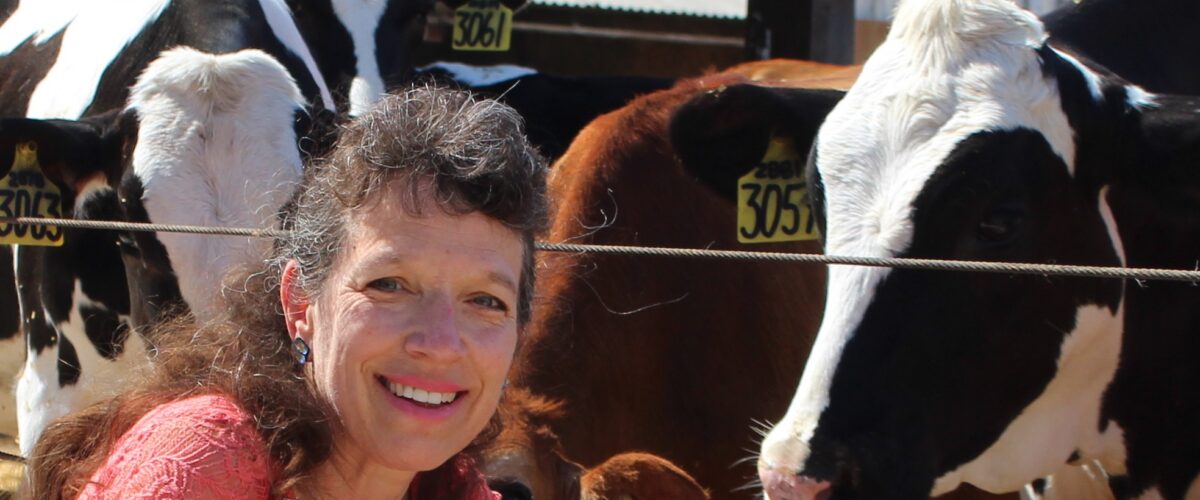
In the Spotlight: Meet Deanne Meyer, researcher at UC Davis, UC ANR
March 4, 2026
Dairy Soil & Water Regeneration (DSWR) is tapping into the talents of the best and brightest researchers in the U.S. They’re doing work through eight research institutions in major dairy-producing regions across the country. One of these all-important project partners is Dr. Deanne Meyer, livestock waste management specialist in the Department of Animal Science at UC Davis and the University of California Agriculture and Natural Resources.
Tell us a little about you.
I’ve spent 40 years working with dairy cattle manure. I’m classically trained as a dairy cattle nutritionist, so the need to think about systems started early in my career. My initial work focused on phosphorus runoff from dairies around Lake Okeechobee, Florida. In California, where most of the state has greater evaporation than precipitation, the issues of concern are different than those in Florida. We are primarily focused on nitrate contamination of groundwater and salt accumulation in soils.
What is your role in DSWR?
The California DSWR project encompasses an almond site and a forage site. My role is to ensure the scientists at both sites communicate effectively, particularly around malfunctioning equipment, transferring equipment and samples between sites, reviewing data in a timely manner and administering our financial and reporting obligations.
We have a super collaboration with Dr. Sat Darshan Khalsa and Dr. Will Horwath at the almond site with their understanding of the interaction of soil parameters, irrigation water management and fertilizer applications. Dan Rivers and Adolfo Coyotl have worked tirelessly on the almond site.
Nick Clark has overseen the forage site. With double cropping, the amount of field work never ends. Ruben Chavez and Pahoua Yang did the heavy lifting of field work along with contributions from Luke Paloutzian, Brady Holder and others. Every forage harvest included an all-hands-on-deck call. Joyce Pexton conducted quality assurance and quality control of manure data and kept a running list of action items handy so everyone knew what was expected.
What is the focus of your research and how does the research at both sites complement each other?
This project provides information about the use of manifested, or transferred, manure on lands not associated with dairies, i.e., almond orchards, and provides information to better understand nitrogen applications and uptake in both almonds and forages. The multi-year study at both locations provides an incredible amount of information for agronomists and water regulatory staff to learn from.
This research is expensive and takes years and an army to conduct. For an agency, company or group to want to fund the basic work to understand nitrogen management is rare. That is what makes DSWR unique, supported by major funding from the Foundation for Food & Agricultural Research and matching funds from companies like Dairy Management Inc., Newtrient, Nestlé and Starbucks.
What is the significance of a project like this in California?
California is facing an imperfect storm. Implementation of the state’s Sustainable Groundwater Management Act will have farmers fallowing fields (intentionally leaving fields unseeded) in areas where no surface irrigation water exists. Additionally, new regulatory obligations related to nitrogen management could occur as soon as 2026. California’s nitrogen restrictions will require manifesting more manure offsite for many dairies. Solid manure is the logical form to manifest due to its denser nutrient composition and economical transfer.
Prior to this project there was insufficient information to understand the utilization of dairy manure compost in orchards. The work at both the almond and forage sites are the first-ever detailed analyses with manure applications. Irrigation water management is important to manage nitrogen and salts and to grow crops when water allocations will be restricted. DSWR looked at it all — the soil, soil amendments, water use and crop/tree management and yields.
These days, everyone is talking about circular economies, the practice of reusing resources and reducing waste. Dairies practice this in part with their nutrition program by feeding byproducts and growing their own forages. For example, almonds have hulls, shells and nuts. The hulls are an excellent fibrous feed ingredient in dairy cattle rations, and the shells can be mixed with hulls and fed to cows or used for bedding, while the nuts are for human consumption. Manure from cattle is used to fertilize crops and can be exported to orchards as fertilizer.
What personally excites you about your work on the project?
Gaining knowledge about the interaction between the carbon and nitrogen cycles when manure sources are used in farming is exciting. It’s been great to soak up information from my colleagues and ask questions to better understand both the forage and almond systems. Whether it is chemistry in the cow, soil or plant systems, it’s been fun to apply what I know to different systems and learn. Every day is an opportunity to learn something new.