Results from soil health assessment in Driftless Region of Wisconsin serve as focus of first in series of webinars
April 1, 2026
The Driftless Region in Wisconsin is marked by hills, valleys and rugged features, an area spared from the last glacier. It also holds thousands of acres of fertile cropland used to grow forage for an estimated 2,000 dairy herds.
The area is one of five dairy regions in the U.S. where scientists sampled soils to create a baseline of soil health and carbon storage in the first phase of the Dairy Soil & Water Regeneration (DSWR) project.
Collaborators in DSWR explored the results of the baseline survey and the impact of various practices in the Driftless Region during a webinar on March 19 that featured a presentation and a panel discussion. The event, hosted by Newtrient, LLC, was the first in a series titled “Assessing the Health of Dairy Forage Fields: Insights from the Dairy Soil & Water Regeneration Project.”
Watch the webinar here: https://www.youtube.com/watch?v=8_6CUpZLjtk
Download the Driftless Region report here: https://soilhealthinstitute.org/app/uploads/2026/02/Driftless-regional-report.pdf
Highlights from the webinar:
National insight from locally grounded research efforts
Dr. Kathy Boomer, a scientific program director for the Foundation for Food & Agriculture Research (FFAR), a major supporter of DSWR, opened the webinar and described the project as “a catalyst for moving beyond simply demonstrating that a (farm management) practice works but understanding when and where it can deliver the greatest benefits when properly designed and maintained.”
DSWR is an eight-year multistate project studying soil health and manure management and their effects on greenhouse gas reduction, water quality improvement and agronomic factors such as forage yield and quality. The project was initiated by Dairy Management Inc. (DMI) and the Soil Health Institute (SHI) in collaboration with research partners at seven universities and USDA’s Agricultural Research Service. Companies such as DMI, Newtrient, Nestlé and Starbucks provide matching funds for the research.
Boomer also listed other attributes of the project that drew FFAR’s interest: “Demonstrating a scalable model for building national insight from locally grounded research efforts. A path from local innovation to national synthesis. A model that demonstrates how we can stitch together the fantastic work happening across our universities with USDA research and local knowledge to better support our farmers.”
Reducing soil disturbance and maximizing living roots
In the Driftless Region, samples from 57 fields on 31 farms were analyzed to assess the current and potential health of soils in the area and which management practices are helping farmers reach their sustainability goals, said Dr. Mara Cloutier, a research soil scientist and program director at SHI who oversees the organization’s scientific and data management contribution to DSWR. Cloutier presented the findings of the survey and moderated the panel discussion.
During her presentation, she laid out the main objectives of the assessment:
- Provide farmers with information needed to understand how healthy their region’s soils are under different management practices and how healthy they can be.
- Provide milk cooperatives with the information needed to understand how healthy the soils in their supply shed are and could be, to support resource allocation.
- Fill scientific knowledge gaps about the state of soil health on commercial dairy farms.
SHI researchers took three key measurements:
- Soil organic carbon, which indicates soil structure, microbial activity, water retention and nutrient availability.
- Aggregate stability, which assesses soil structure and resistance to erosion. A high soil aggregate stability improves aeration and water movement, two factors important for crop growth.
- Carbon mineralization potential, or the amount of carbon dioxide produced by microbes after rewetting the soil. This indicates the capacity of the soil to cycle plant residue and nutrients.
Common crops in rotation in the sampled fields were corn silage, soybeans and alfalfa. Various tillage and cover cropping practices were among the management styles.
Cloutier pointed to two general overall findings:
- Well-managed rotationally grazed pastures have the greatest soil health in the region.
- Putting soil health principles — minimizing disturbance and maximizing living roots, soil cover and biodiversity — into practice in row crop systems showed measurable soil health improvement.
“The results show that growers in the Driftless Region improved their soil health by adopting management practices to reduce soil disturbance and maximize living roots,” she said.
Managing these systems for soil health is dynamic
The University of Wisconsin-Platteville, located in the Driftless Region, is participating in DSWR, with a focus on the effects of soil health management practices on surface water runoff and water quality.
Researchers at the university’s Pioneer Farm research dairy are evaluating two dairy-focused crop production systems. One is a soil health management system where a corn silage crop is fertilized via surface-broadcast using a flocculated solids manure product, supplemental nitrogen is applied according to a soil nitrogen test and cover crops are established immediately after harvest. The second system is a conventional system in which the corn silage crop is fertilized with fall-injected liquid dairy manure, supplementary nitrogen needs are met by a spring urea application followed by disk incorporation and no cover crops are planted.
This research is being conducted in eight replicated catchments, with one of two treatments randomly assigned to each catchment.
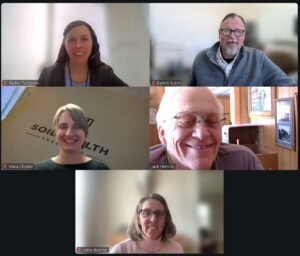
Dr. Dennis Busch, principal investigator for the extensive field trial at Platteville, was a panelist for the webinar.
“Generally speaking, yes, if we’re going to reduce our tillage and we’re going to have cover crops, typically like on a single farm, … you will improve your water quality outcomes,” Busch said.
Those outcomes are reduced surface water runoff, soil erosion rates and nutrient losses.
“However, there’s no free lunch,” Busch said, recounting a dry early spring in 2023 when he and his team decided not to terminate the cover crop and planted green. This removed significant amounts of water from the soil profile, resulting in a 20-25% reduction in silage yields.
The following year, they terminated the cover crop early. “And then we saw an impact on our water quality outcomes in that we had higher runoff rates, we had higher erosion rates and higher nutrient losses,” he said.
“So, I think … managing these systems for soil health is really dynamic and you have to be adaptive.”
And that’s what he is noticing among local dairy farmers.
“It’s really interesting to me to see that they’re not only adopting these soil health practices like cover crops, but how they leverage that practice to address … heavier (manure) application rates,” Busch said.
Meeting farmers where they’re at on their sustainability journey
Rachel Turgasen, a dairy farmer in the region, also participated in the soil survey and as a panelist during the webinar.
Turgasen is also vice president of member and corporate relations and sustainability at Foremost Farms USA, a member-owned dairy cooperative with 600 dairy farm families located in seven states across the Upper Midwest. The farms are diverse in size, scale and production systems.
At Foremost Farms, soil health is integrated into the cooperative’s responsible dairy strategy through elements like environmental stewardship commitment, farm resilience, farmer livelihood and long-term cooperative value, Turgasen said.
“We recognize that it’s important to have farms that are willing to step up through voluntary engagement and to leverage their expertise and things that they’re interested in,” she said.
Foremost Farms became an active participant in DSWR when the Innovation Center for U.S. Dairy established a set of collective environmental stewardship goals for the dairy industry. The aim of the program is to advance progress toward those goals.
“Dairy farms are already doing amazing work in sustainability and environmental stewardship,” Turgasen said. “It’s also fair to say that we need to meet farms where they’re at on their journey. All farms are different and every farm is starting in a different place.”
A generational commitment to building soil health
Driftless Region dairy farmer Jack Herricks has been no-tilling on his cropland since 1985.
“You have to realize in the area that we farm in, instead of talking about topsoil in feet, we talk about the amount of topsoil in inches. And that topsoil is just such a precious resource that I realized, fortunately early in my career, that we’ve got to keep this here,” said Herricks, who participated in the baseline survey and was one of the panelists in the webinar.
“And so our objective with no-till with cover crops is to absolutely keep as much of our soil in place as possible, to keep it healthy, to keep something green on it, keep roots in it, and go from there.”
The multigenerational Herricks Dairy Farm milks 600 crossbred Holstein, Jersey and Brown Swiss cows and grows crops on 1,500 acres.
The Herricks’ approach to soil health management is long-term, given the common season-to-season changes in conditions.
“We need to be profitable from year to year to year, but these practices I view more as generational,” Herricks said. “We need to … build our soil health, and it’s something that takes a long time. It doesn’t happen fast. You’ve got to have some knowledge and a little faith.”
He said he realizes that deciding to implement soil health management practices can be difficult for farmers because of long-held beliefs and the financial risks.
“My suggestion usually is to kind of nudge your way into it,” Herricks said, suggesting, for example, borrowing rather than buying a planter for cover crops.
“You’ve got to be willing to kind of step out of your comfort zone and try something different and try to improve how you do things and not be satisfied with the status quo.”