On the Farm: Data is driver for Vermont dairy’s involvement in DSWR
October 26, 2026
Producing relevant and reliable data for dairy farmers is the key aim of the Dairy Soil & Water Regeneration (DSWR) project. That is why Audet’s Blue Spruce Farm in Bridport, Vermont, is participating in the project, says farmer Marie Audet.
On the commercial dairy, University of Vermont researchers are comparing the effects of conventional practices with a soil health management system and a flocculated solids treatment. Surface and subsurface water quality is a major focus.
Audet shared what drives sustainability on her family farm and how DSWR aligns with that mission.
What does sustainability mean to your farm?
At Blue Spruce Farm, sustainability means meeting the needs of our family and employees while operating a dairy farm that supports healthy, comfortable and productive cows. It also means protecting and improving the environment and contributing positively to our community.
What are you doing at your farm to be sustainable?
- Protecting the soil: Dairy farming continues to evolve through research and innovation. Over the past decade, we have invested heavily in practices that improve soil health. We use minimal tillage planting methods that place seeds directly into the soil while preserving soil structure, organic matter and beneficial soil biology.
- Anaerobic digester: We process manure through an anaerobic digester that captures methane and converts it into renewable electricity. Plant fibers are separated and reused as comfortable bedding for our cows, while the remaining liquid passes through a dissolved flotation system that removes 70% to 78% of the phosphorus. This system allows us to more precisely recycle nutrients back into the soil, creating a closed-loop cycle that supports both crop production and renewable energy generation.
- Grain mill: In 2022, we focused on reducing one of the largest expenses on a dairy farm: feed. We built a grain-processing facility to mill our own corn and soybeans. The soil investments we had already made gave us the foundation to become more self-sufficient.
- Machinery shop: In 2014, we took advantage of strong milk prices and built a modern machinery shop as a member of the next generation returned home after completing diesel mechanic training. Today, we perform most equipment maintenance and repairs in-house, improving efficiency and reducing costs.
Why do you feel it is important for your farm to participate in DSWR?
Continuous improvement requires reliable data, resources and guidance to support informed decisions and investments. DSWR is among the first programs in the country to examine the direct relationship between soil health, water quality and methane and nitrous oxide. This information is essential.
What do you hope comes from your participation in the project?
The research is being done right here in Addison County, Vermont. Participating in a study of this magnitude will test the new practices and technology where we all live to help us get to the future we want. A tile drainage system in which researchers are monitoring subsurface runoff, for example, is a tool that could enhance our ability to manage extreme weather events and support our conservation practices.
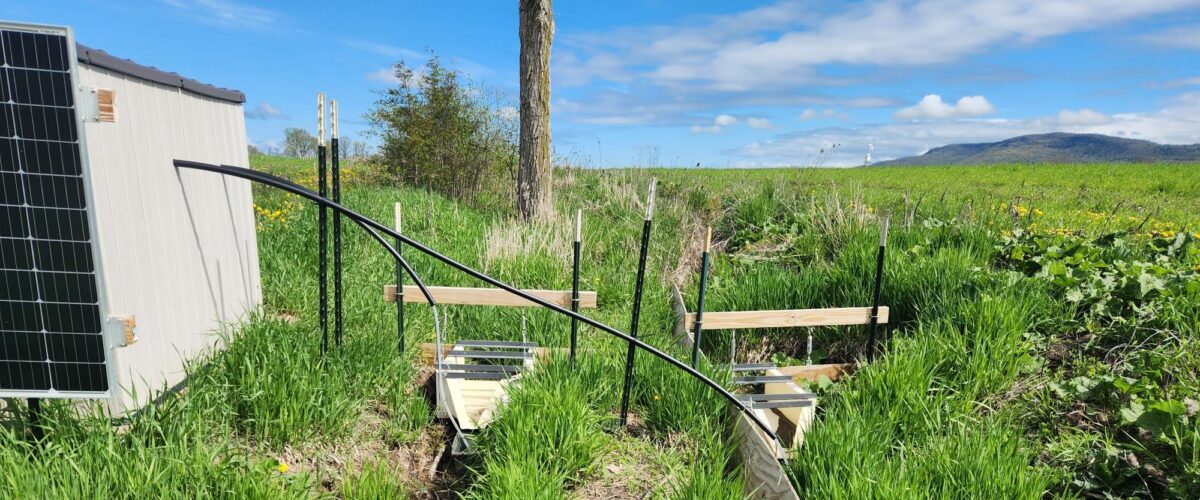
Photo: Two fiberglass flumes installed at Blue Spruce Farm are used to monitor surface water volume and quality in runoff from fields being managed with conventional and soil health practices. When a storm event or snowmelt happen, automatic water samplers are triggered.