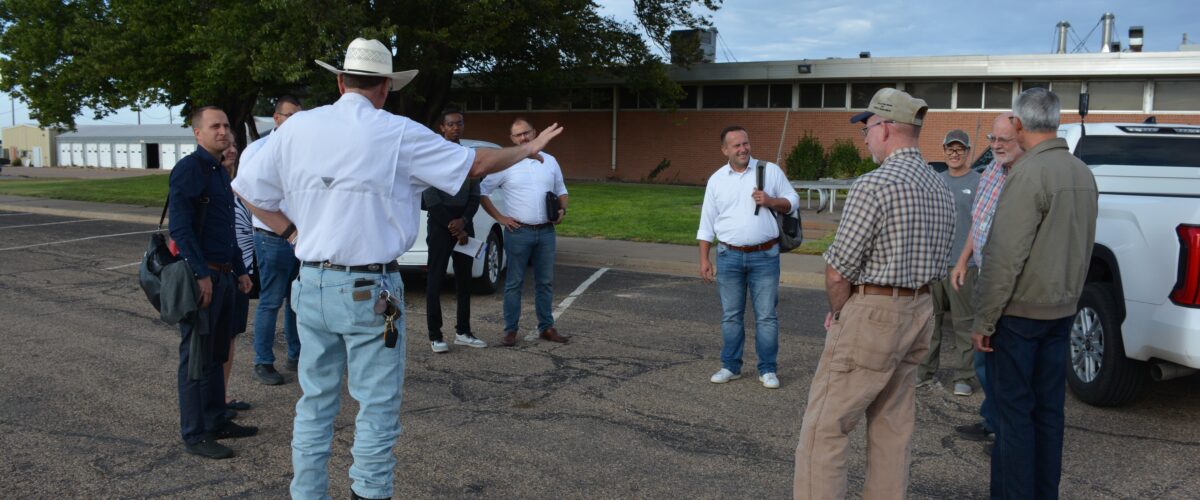
Hungarian university visitors observe DSWR sorghum research in Texas
November 24, 2026
Dairy Soil & Water Regeneration (DSWR) research in Texas had an international audience this fall when Texas A&M AgriLife welcomed visitors from Hungarian University of Agriculture and Life Sciences.
The university is one of the largest agricultural-focused, multi-disciplinary higher education institutions in Europe.
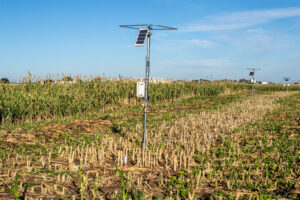
As part of DSWR, researchers at Texas A&M AgriLife are conducting studies on an agency farm in the semi-arid Texas Panhandle. They are focused on soil health management strategies related to tillage and nutrient management to produce high-quality forage sorghum silage in a limited-irrigated system.
The small group of visitors observed a DSWR sorghum plot on the farm and received an overview of forage production systems in the state from Dr. Brent Auvermann, director of the Texas A&M AgriLife High Plains Research and Extension Center and principal investigator for the DSWR research there.
Texas is one of six major dairy-producing states where teams from eight institutions are partnering in DSWR to study soil health and manure management and their effects on methane and nitrous oxide, water quality and conservation, and agronomic factors such as yield and forage quality.
Hungarian University of Agriculture and Life Sciences, founded in 2021, is quickly establishing itself as a leader in regenerative agriculture research programs.
Main image:
Dr. Brent Auvermann (cowboy hat), director of the Texas A&M AgriLife High Plains Research and Extension Center, introduces a visiting group from Hungarian University of Agriculture and Life Sciences to leaders of the USDA ARS Plains Area Conservation and Production Research Laboratory in Bushland, Texas. (Photo by Kay Ledbetter/Texas A&M AgriLife)
Secondary image:
The partially harvested sorghum plot at the DSWR site on a Texas A&M AgriLife research farm. (Photo by Hannah Lang/Texas A&M AgriLife)