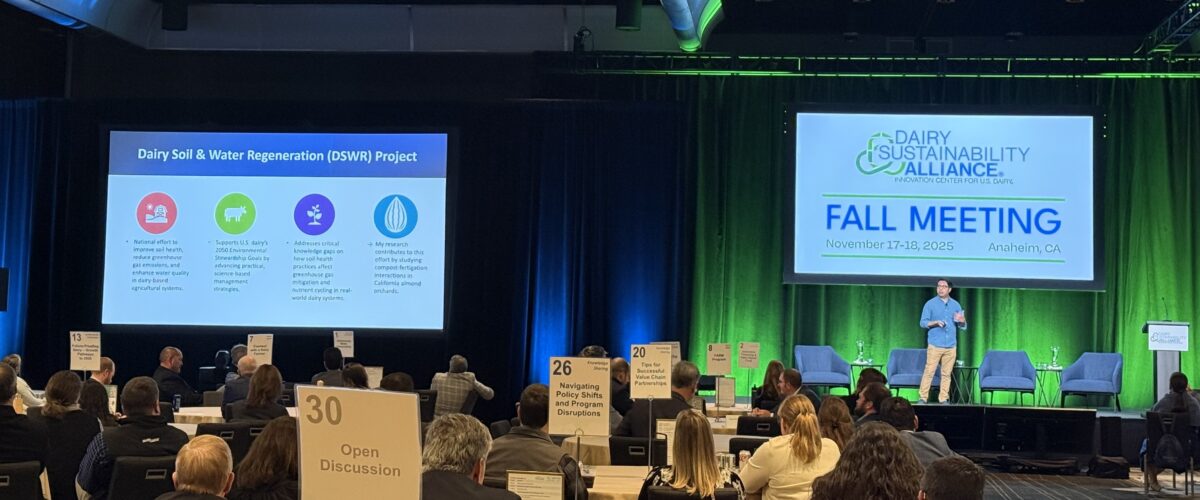
Almond orchard research highlights circularity at Dairy Sustainability Alliance Fall Meeting
December 10, 2025
Dairy Soil & Water Regeneration (DSWR) research in California served as an illustration of the emphasis placed on real-world applicability of the project by farmers, technical experts and sustainability leaders at the 2025 Dairy Sustainability Alliance Fall Meeting on Nov. 18 in Anaheim, Calif.
Adolfo Coyotl, a Ph.D. student researcher at the University of California, Davis, highlighted his work on a commercial almond orchard in a presentation titled “Advancing Dairy Circularity through the Soil.” The study, conducted by UC Davis and University of California Agriculture and Natural Resources, explores how the use of composted dairy manure as fertilizer, combined with fertigation, can improve soil health, enhance crop yields and reduce greenhouse gas emissions.
The universities are among eight research institutions across the country partnering with Dairy Management Inc. and the Soil Health Institute on the eight-year DSWR project to advance progress toward the dairy industry’s collective 2050 environmental stewardship goals, which were established through the Innovation Center for U.S. Dairy.
The project is studying soil health and manure management and their effects on greenhouse gas (GHG) emission reduction, water quality improvement and agronomic factors such as forage yield and quality. Extensive trials are taking place on research farms and commercial dairies in six states. The goal is to inspire confidence in on-farm decision making through practical, data-driven sustainability strategies.
Coyotl said findings to date in the almond orchard study point to promising gains in dissolved soil organic carbon, reduced nitrous oxide emissions and stable yields, while showcasing new opportunities for dairy farmers regarding manure reuse and additional revenue streams.
He presented several key implications of the research:
- Soil health practices are feasible and effective on commercial farms.
- GHG reductions achieved without lowering fertilizer inputs encourage wider adoption.
- Improved soil structure, water retention and tree vigor are co-benefits.
- The overlap between dairy and almond production regions supports a circular nutrient economy.
- Integrating dairy compost into orchard management offers a scalable, sustainable solution for California agriculture.
A follow-up roundtable discussion focused on how learnings from studies like those in DSWR can be implemented.
Coyotl led the discussion along with Jamie Vander Molen Boehl, senior vice president of sustainability initiatives and business development at Newtrient, which is a key industry partner in DSWR.
“Exploring the circularity between almond farms and dairy farms exemplifies a sustainable approach to agriculture, where waste from one sector becomes a resource for another,” Vander Molen Boehl said.
“There is strong interest in scaling similar practices to foster greater environmental impact and resilience.”
More than 270 leaders from across the dairy value chain gathered for the Fall Meeting. This was Coyotl’s first experience attending a national multi-stakeholder conference. The Dairy Sustainability Alliance, an initiative of the Innovation Center, includes more than 200 companies and organizations.
“It certainly was inspiring to witness the dedication and purpose the industry holds toward achieving sustainability goals,” Coyotl said.