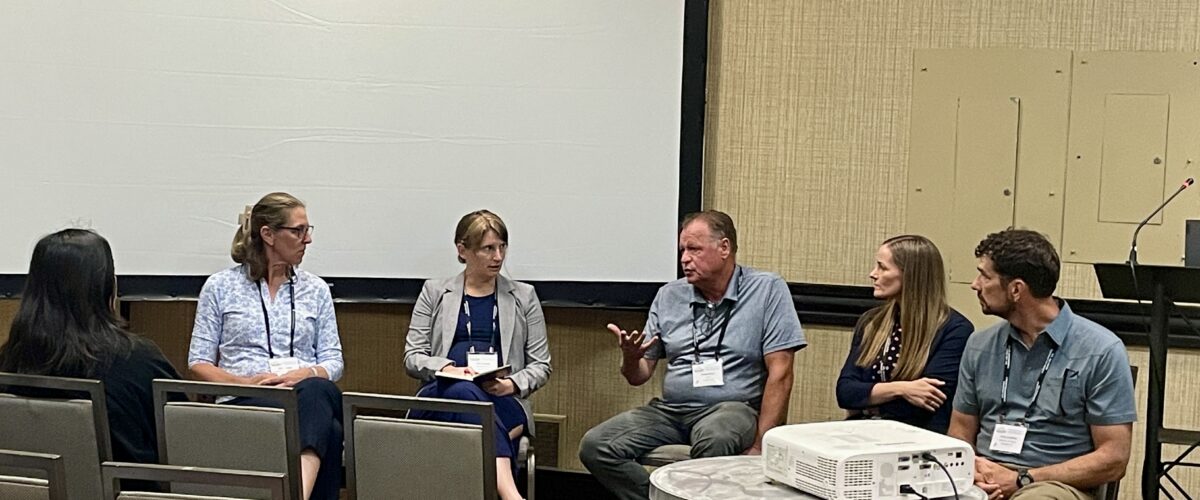
DSWR presentations, panel contribute to dialogue at Soil and Water Conservation Society meeting
September 24, 2026
Dairy farms play a critical role in the health of soil and watersheds across agricultural lands. Uncertainty remains, however, around how specific farming practices influence the hydrologic processes that affect those outcomes.
Scientists associated with the Dairy Soil & Water Regeneration (DSWR) project sought to provide clarity on those impacts at the Soil and Water Conservation Society’s annual meeting this summer in St. Louis. The conference, with the theme “Gateway to Conservation,” brought together researchers, practitioners, industry leaders, farmers and students from around the world.
During a symposium, the DSWR participants shared insights on soil-hydrology interactions based on emerging findings from the project, which aims to quantify links between dairy forage management, soil properties and processes and water dynamics. The researchers talked about how farming practices affect water movement and quality, pointed out knowledge gaps in the space and discussed implications for conservation planning and investment across diverse dairy landscapes.
The session featured presentations and a panel discussion around on-farm experiments in Vermont and Wisconsin exploring how soil health practices influence infiltration, runoff and nutrient movement. The researchers also talked about the findings within broader hydrologic and conservation frameworks and their relevance to modeling, regulations and the on-farm adoption of practices.
Dr. Mara Cloutier, a research scientist and program director at the Soil Health Institute, a DSWR research partner, moderated the session. Cloutier oversees her organization’s scientific and data management contribution to the project.
Highlights from the panel participants:
Dr. Kathy Boomer is a scientific program director for the Foundation for Food & Agriculture Research, which is a major supporter of DSWR.
Boomer laid out the rationale of priorities for sustainable water management and highlighted how DSWR fits within those priorities.
She acknowledged how hard the DSWR teams have worked to determine the effects that soil and water regimes have on nutrient uptake, loss, and leaching. She also stressed the importance of considering the broader context.
“Our tendency is to think about how well a farming practice is performing comparatively without considering the landscape setting. That is a challenging question,” Boomer said. “Before one thinks about a practice, we need to know where the field is situated and how water is moving through that system. Then, we can start to think about which practices, or how to stack practices, to drive the intended outcomes.”
“I want to acknowledge what this work is uncovering, but also emphasize that we still have a lot of work to do in this space,” she said.
Boomer said DSWR’s emphasis on water’s role in soil health is important.
“A really exciting outcome for me as a water scientist is to see the agronomy community rallying around how important water is to soil health outcomes and elevating the need to understand those linkages more. The work that comes out of this program and this partnership provides a foundation for how to approach and build on that work.”
Overall, Boomer said, she is impressed by the project’s collaboration across different geographies in six states, from California to Vermont.
“It’s important to reflect on where this project started. Even though the DSWR team believed they were approaching the research with the same conceptual framework, it quickly became apparent that there were many different ideas about how to collect even the same data. The work that went into fostering alignment across the collaboration should be celebrated. That experience is also important for informing future hub-based research programs that are trying to promote this kind of collaborative approach.”
Hear more from Boomer in this video clip.
Dr. Dennis Busch is a senior scientist at the University of Wisconsin-Platteville and the principal investigator for the project at the university’s research farm.
Busch presented field-scale findings to date from Platteville evaluating relationships between dairy forage management practices, soil health indicators and hydrologic responses measured through runoff, rain simulation and the movement of water and nutrients through the soil.
He also addressed how the project is capturing the impact on economics. The team is recording management activities to develop outcomes based on practices being used in two different systems — conventional and soil health management. The top consideration for farmers is typically whether a change in practices will cut into crop yield, Busch said.
“So far what we’re seeing, at least from the income side, is that there is not a significant difference in our productivity between these different systems. There has not been a yield reduction,” he said.
An unknown factor, he said, is the economics of using a prototype technology that produces flocculated manure solids, a fertilizer that is being imported from another farm for this project.
“The bottom line I think is we can achieve pretty good environmental outcomes without changing costs,” Busch said.
Hear more from Busch in this video clip.
Dr. Joshua Faulkner, a research associate professor at the University of Vermont who leads the university’s DSWR research, reviewed field-scale research on a commercial dairy examining forage management impacts on soil and water processes in humid, rain-fed systems.
Faulkner said the comprehensiveness of the project is unlike any in his experience.
“I’ve been working on dairy systems in Vermont for many years, and what I’ve found really unique about this project is the whole-systems approach we’re taking,” he said. “We’re measuring greenhouse gas emissions, we’re looking at a suite of soil health indicators including deep soil carbon sequestration, we’re looking at water quality and we’re looking at crop production and economics. And all of that’s happening on the same fields.”
“It’s like a giant laboratory out in this dairy production field. That’s really cool and very unique,” Faulkner said.
Hear more from Faulkner in this video clip.
Dr. Meredith Niles is a professor of behavioral and social sciences and a professor of environment and society at Brown University. She discussed findings from a soil health-hydrology expert survey, conducted as part of DSWR, and highlighted areas of consensus, uncertainty and research needs linking crop management to water outcomes.
Completed by hundreds of soil health researchers and practitioners, Niles helped the DSWR team use structural equation modeling to understand how those experts perceive the role of soil health practices in agroecosystem outcomes.
While the modeling for the survey was based on people’s perceptions, Niles said DSWR researchers could leverage this type of model by using biophysical data to more deeply explore the relationship between soil health and hydrology.
“Rather than only looking at the direct relationship of soil health practices to certain outcomes of interest, like nutrient loss or runoff, for example, make sure you’re thinking about indirect effects that might happen in your water system or within your landscape,” she said.
Hear more from Niles in this video clip.