DSWR researchers at UW-Platteville join farmers for field day
November 17, 2026
Connecting applicable research with farmers is fundamental to the Dairy Soil & Water Regeneration (DSWR) project.
University of Wisconsin-Platteville researchers took an opportunity to do so by participating in a field day in August hosted by a farmer-led watershed conservation group in southwestern Wisconsin.
The event took place at Berget Family Farms, a member of the Lafayette Ag Stewardship Alliance. The Bergets grow corn, soybeans and wheat. The family, longtime stewards of the land, have well-established practices such as strip tillage, no-till and cover crops in their field management.
The field day’s 20 attendees examined a plot where the farm is trying various cover crop species.
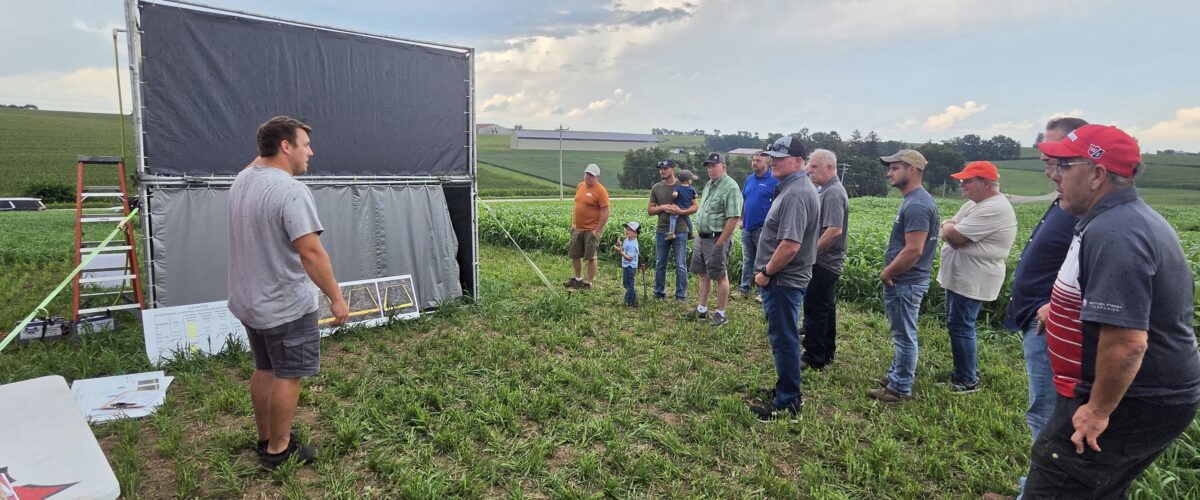
The attendees also heard about the purpose of DSWR and the field applications, sampling methods and rainfall simulator being used in the project at the University of Wisconsin-Platteville’s nearby Pioneer Farm, said Tristan Martins, a technician there.
Through DSWR, the Platteville team is evaluating the impacts of two dairy-focused crop production systems on soil health, water quality, carbon storage and crop yield. One of the systems involves soil health management practices that incorporate novel manure products and cover crops. The other is a conventional system that uses liquid dairy manure and no cover crops. Surface water quality, a key focus of the research, is being evaluated in eight replicated edge-of-field catchments.
Martins said the majority of questions from attendees at the field day were about lysimeters, a tool the researchers are using to measure water and nutrient movement in the soil. They were also interested in the rainfall simulator.
“The attendees liked the idea of the rainfall simulator, which can give great estimates of surface runoff within any field setting,” he said. “This also helped them realize how important cover crops can be in the fall and spring to reduce erosion.”
Among the cover crops the Bergets are experimenting with are rye and oats, two species used in the studies at Platteville.
Jim Winn, a dairy farmer from the area and president of the Lafayette Ag Stewardship Alliance, said cover crops have been a focus for his group since its start in 2017 and their use continues to increase.
“To see the interest farmers still have in cover crops is very gratifying,” Winn said.
Caption: Tristan Martins, a research technician at the University of Wisconsin-Platteville, explains how a rainfall simulator is being used in DSWR studies during a field day at a commercial farm arranged by the Lafayette Ag Stewardship Alliance.