DSWR study contributes to quantifying nitrogen fertilizer replacement value of manure for New York dairy farmers
April 28, 2026
When managed carefully, livestock manure has proven to help build soil organic matter, enhance plant nutrient cycling and improve overall soil health and climate resilience over time.
Determining just how valuable the nitrogen in manure can be for farmers who are growing crops has been the aim of a multiyear statewide study in New York conducted by Cornell University. Research that Cornell is conducting as part of the Dairy Soil & Water Regeneration (DSWR) project is contributing to the study.
The researchers reviewed the findings of the study during a webinar on April 3 as part of a monthly series by Cornell’s College of Agriculture and Life Sciences and its Nutrient Management Spear Program (NMSP). The webinar, titled “The Value & Power of Manure,” featured Dr. Quirine Ketterings, professor of nutrient management and NMSP director, and Juan Carlos Ramos, on-farm research coordinator for NMSP.
Click here to watch the webinar recording.
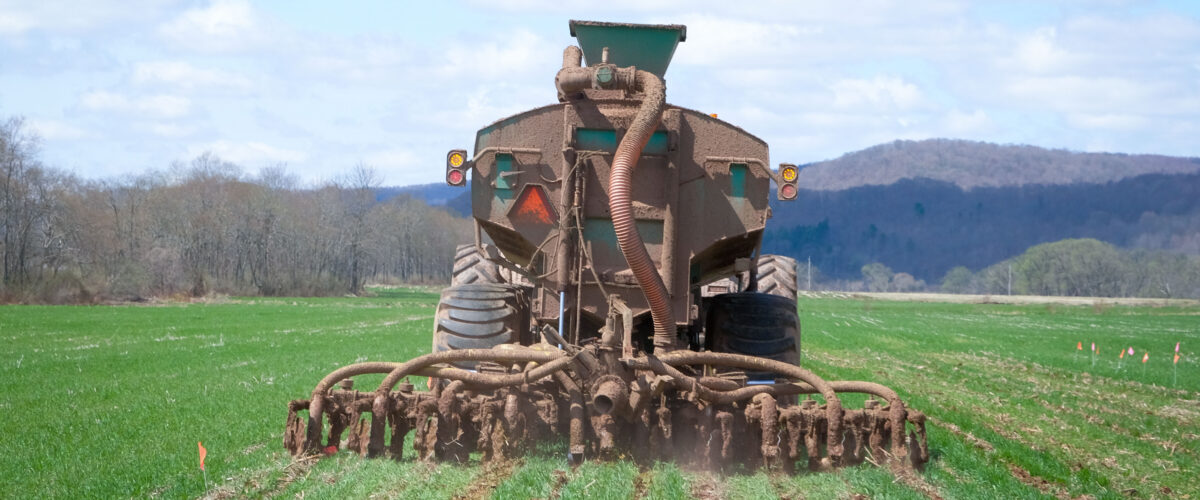
Cornell’s goal with the Value of Manure study is to quantify the impact of manure application on nitrogen fertilizer needs and crop yield, based on earlier observations that manure effectively offsets commercial nitrogen fertilizer and boosts yields beyond what can be achieved with commercial fertilizer alone, Ketterings said. These nitrogen replacement trials, including one in the DSWR project at Noblehurst Farms in western New York, are being used to update nitrogen crediting systems created years ago at Cornell.
“We initiated this statewide project because manure sources that farms have now are no longer limited to just liquid untreated dairy manure or drier stacked manure,” Ketterings said.
Today’s manure increasingly is treated to generate separated solids and liquids, digestate and products like the evaporative and flocculated solids that were incorporated in the DSWR nitrogen replacement study.
“Being able to conduct such nitrogen replacement studies with these novel manure products will help with ensuring appropriate value allocation to these materials,” Ketterings said.
Ramos said management is important when using manure.
“We are learning that manure is a great fertilizer. It can reduce our reliance on synthetic fertilizer as well increase sustainability,” he said. “But it also comes with some challenges especially because the nutrient composition in manure can be quite variable. So it can be difficult to manage the variability and how much nutrients you are applying to a field.”
Among key points Ramos presented in summarizing the webinar:
- Manure contains all 17 plant-essential nutrients.
- The method and timing of application determine the nitrogen value of the manure.
- Manure can offset the need for inorganic fertilizer and increase corn yield, with positive effects into the second and third years.
- The impact and timing of the response in nitrogen and crop yield vary by location.
- Field history is important in evaluating manure’s effect on crop yield.
Check out Cornell’s Value of Manure Calculator:
https://valueofmanure-nmsp.glide.page/dl/09d2f0