DSWR’s almond orchard research part of California grower workshop
May 20, 2026
A conservation agency in west-central California featured research in the Dairy Soil & Water Regeneration (DSWR) project as part of a workshop for almond growers in early May.
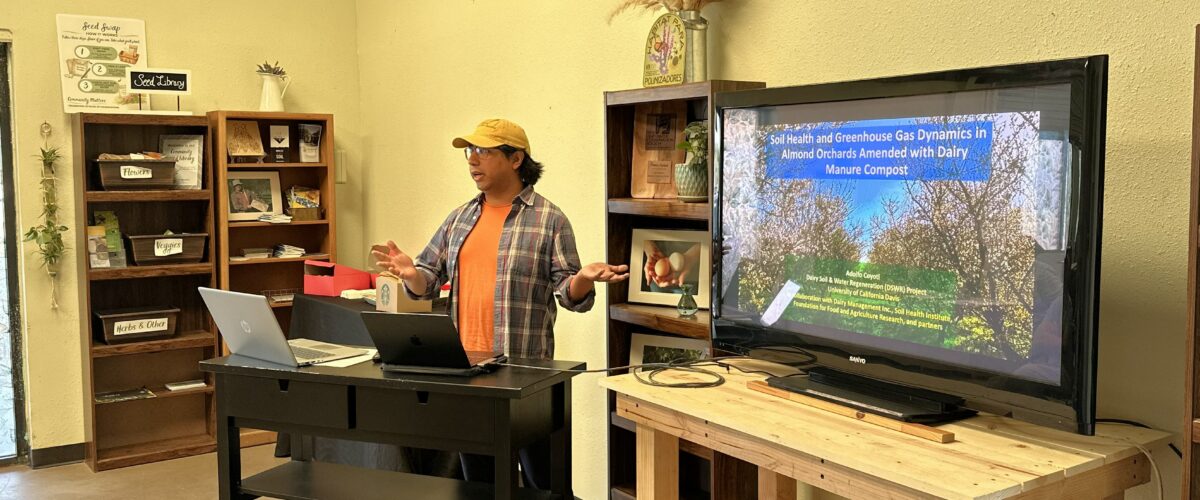
The event, hosted in Ceres by the East Stanislaus Resource Conservation District (ESRCD), focused on stacking regenerative practices. Adolfo Coyotl, a Ph.D. student at the University of California, Davis, which is a partner in DSWR, was among presenters.
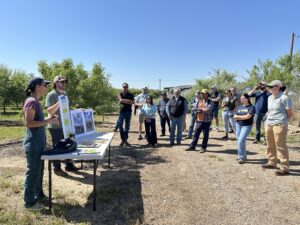 ESRCD staff highlighted the importance of regenerative practices in almond production systems and led in-field demonstrations of soil health practices such as cover crop implementation, biochar addition and compost application for an audience of growers, farm managers, consultants, agricultural agency members and other participants.
In the DSWR project, the UC Davis team is evaluating standard fertigation and the combination of fertigation and composted dairy manure in almond production to enhance yields, improve soil health and reduce greenhouse gas (GHG) emissions.
Coyotl spoke on how dairy manure compost applied in a commercial almond orchard over the past few years as part of DSWR has synergized with conventional fertilization practices to promote soil health as well as yield and agronomic performance. He explained how increased and improved soil organic matter boosted soil nutrient cycling such that synthetic nitrogen is more efficiently processed, decreasing GHG emissions.
In response to the dairy manure compost addition, almond trees produced stable yields compared to the non-amended trees despite drought-like conditions, demonstrating climate resilience, Coyotl said. In addition, all compost-amended almond trees grew bigger and faster than the conventionally fertilized trees, potentially locking away more carbon within the increased biomass.
Coyotl said the workshop was a unique opportunity to engage with growers and farm managers firsthand.
“I usually present to researcher- or industry-oriented meetings, so a grower-specific meeting was novel. This was reflected in the kinds of questions I was asked which were geared toward the practical applications of the research, such as the timing and rate of organic amendment application,” he said.
“It was quite educational to hear about challenges growers experience and the creative problem-solving when it comes to incorporating regenerative practices into their orchard systems.”
Victor Jacobs, ESRCD’s ag research manager, was impressed by Coyotl and his work in DSWR.
“Adolfo did a great job breaking down some really complex ideas in a way that felt clear and relevant,” Jacobs said. “It was great for attendees to see how something like compost can actually play a big role in improving soil health and reducing emissions without sacrificing production.”
ESRCD is a locally led public agency supporting farmers, ranchers, landowners and Stanislaus County residents through conservation, education and restoration. The agency helps coordinate conservation activities in partnership with the U.S. Department of Agriculture and other local, state and federal agencies within the district.
The workshop was funded in part by the Almond Board of California and the Foundation for Food & Agriculture Research, which is a major supporter of the DSWR project.