‘Farming on the edge:’ Semi-arid High Plains is setting for Texas A&M AgriLife research and backdrop for DSWR annual meeting
November 10, 2026
For a stark example of the importance of the Dairy Soil & Water Regeneration (DSWR) project, one needs only to look to the Texas Panhandle.
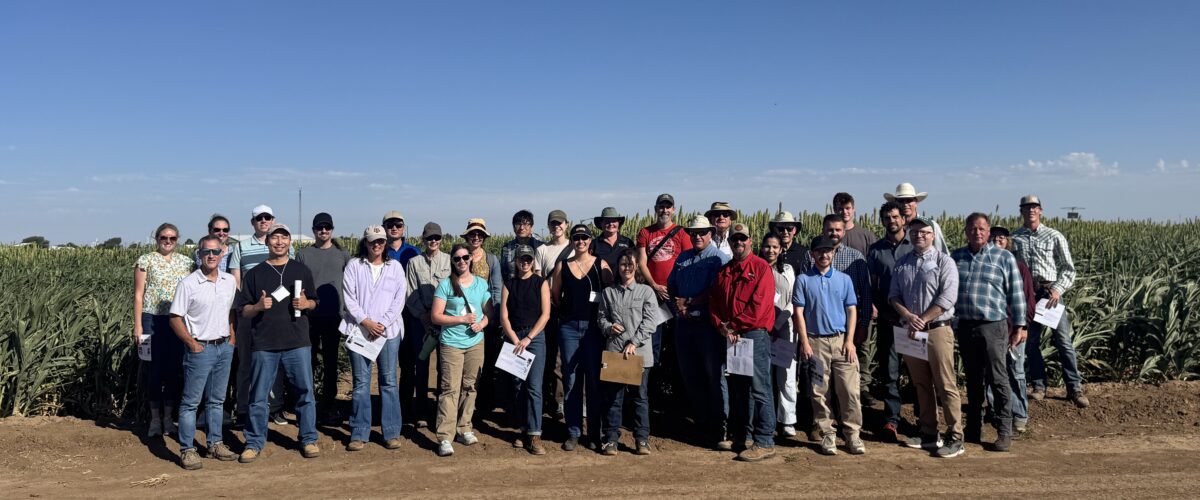
“Farming on the edge of what’s possible” is how Brent Auvermann, professor of agricultural engineering for Texas A&M AgriLife Research, described the challenging environment for beef and dairy farmers in the dry Texas High Plains to dozens of researchers gathered in Canyon, Texas, for the annual DSWR All-Team Meeting in August.
Auvermann is director of the Texas A&M AgriLife High Plains Research and Extension Center in Canyon and principal investigator for the DSWR research being conducted on an agency farm about 20 miles to the northwest in Bushland. Texas is one of six major dairy-producing states where teams from eight institutions are studying soil health and manure management and their effects on methane and nitrous oxide, water quality improvement and agronomic factors such as yield and forage quality.
Water for agriculture and other uses in the semi-arid climate of the High Plains is heavily dependent on the diminishing supply in the Ogallala Aquifer. While averaging about 20 inches annually, precipitation amounts can swing wildly. There had been only a few inches of rain this year in the Amarillo area as of the meeting.
Temperature swings can also be extreme and rapid, dropping 50-60 degrees Fahrenheit within hours. Summer highs average in the 90s and top 100. The region is one of the windiest in the United States.
In these conditions, successfully growing forage crops depends on the alignment of available water in the soil, from the atmosphere and from irrigation, which is affected by seasonal changes in pumping capacity, Auvermann said.
“When you sum everything up, the variability here is so extreme that you’re moving closer and closer to not being able to accomplish the soil health objective while still delivering a crop of forage.”
That is the backdrop for Auvermann’s team, which is focused on developing soil health management strategies related to tillage and nutrient management to produce high-quality forage sorghum silage in a limited-irrigated system.
Presentations demonstrate ‘great progress’
Research teams from all institutions participating in DSWR presented updates on their trials and shared new insights with their counterparts at the meeting. They also heard from the communications team about efforts to publicly highlight the various aspects of the project along with the people involved.
After five years, most of the field work will be wrapped up by the end of this year. Most teams are now focused on analyzing millions of data points collected in the project and sharing results with the scientific community as well as farmers and their advisers.
“All of the teams have made great progress,” said Victor Green, director of soil health and crop sustainability at Dairy Management Inc., which initiated DSWR in collaboration with the Soil Health Institute and eight research institutions across the country, including Texas A&M AgriLife Research.
Green, who serves as overall project manager, said all the research partners have overcome challenges, including midstream site changes for Texas A&M AgriLife Research.
“Flexibility and adaptability are something I credit to all of the teams,” he said.
Field trials and farm tours
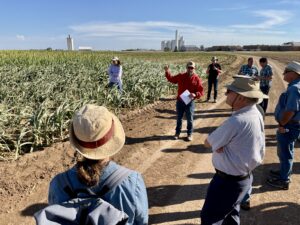
The meeting attendees took to the field at the Bushland site to observe the forage sorghum trials and hear from co-principal investigators Dr. Kevin Helflin, agronomy program specialist, and Dr. Carolina Braga Brandani, soil health specialist.
They also saw the Texas team’s DSWR manure incubation study site, exhibited by Dr. Myeongseong Lee, and visited the site of a U.S. Department of Agriculture’s Agricultural Research Service project related to manure priming, presented by Dr. Anna Ortiz.
Additionally, attendees heard from Dr. Steven Evett and Dr. Jacek Koziel of the USDA ARS Plains Area Conservation and Production Research Laboratory, who provided an overview of the work being conducted at the facility.
Two farm tours were also part of the three-day meeting.
Del Rio Dairy, an open-lot dairy with 8,400 milking cows, uses a biogas digester to produce renewable natural gas from manure. A byproduct of the process is manure compost that is used as a fertilizer.
At 2J Farms, participants learned about how the farm manages forage crops through an irrigated, long-term no-till approach. Attendees learned about the necessity for precise water management in the Panhandle and the soil health, water conservation, and forage yield and quality benefits the farm has seen from the use of no-till.
“The farm tours were excellent,” Green said. “I was impressed by how seriously the farms took the water scarcity issue and used innovative ways to conserve water.”
Design and implementation feedback
Researchers had the opportunity to provide feedback on the design and implementation of DSWR — what went well, what the challenges were and what changes were made.
One challenge cited by some sites, for example, was difficulty in carrying out research-grade trials on working dairies. Although interested in supporting the work, farmers needed to complete field activities that did not always align with the researchers’ timelines. Additionally, some dairies were located far from the research institutions, making the extensive sampling needs untenable.
To address these challenges, research teams met with farmers to better align priorities, and some projects ended up moving to different research sites closer to their institutions.
Another challenge, early in the project, was differing understandings of sampling protocols and how they worked in the many different field settings. In response, project leaders set up monthly team meetings to ensure the same understanding and implementation of the protocols and to receive feedback on how to make those protocols clearer.
The responses about design and implementation will form the basis of a publication on large, multi-site research projects.
Also, a follow-up survey will gather researchers’ suggestions for designing a “DSWR 2.0,” covering aspects like oversight, roles, research coordination, data management and internal communication.