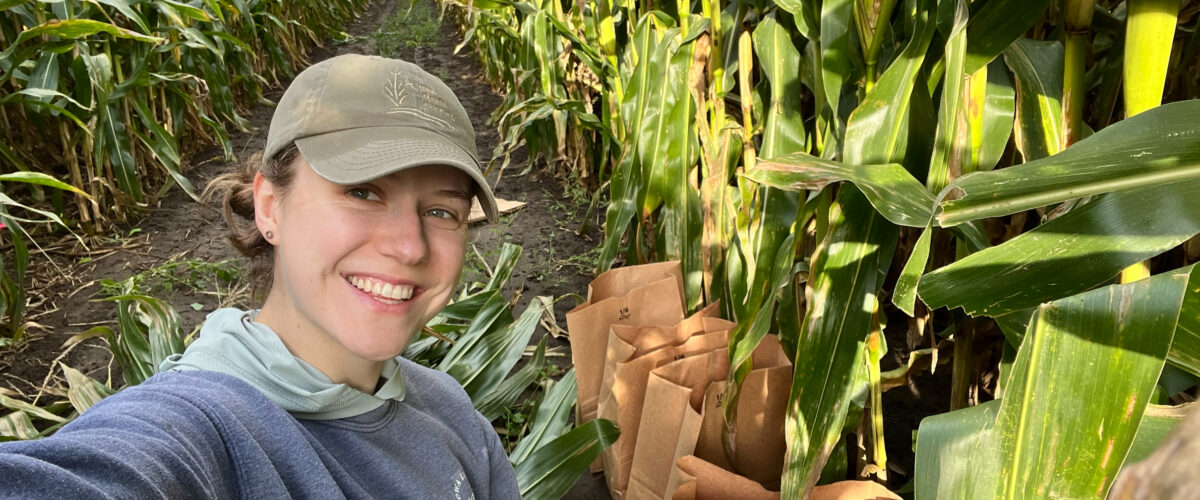
In the Spotlight: Meet UW-Madison research specialist Grace Parrott
October 7, 2026
Dairy Soil & Water Regeneration (DSWR) is tapping into the talents of the best and brightest researchers in the U.S. They’re doing work through eight research institutions in major dairy-producing regions across the country. One of these all-important project partners is Grace Parrott, a research specialist at the University of Wisconsin-Madison.
Tell us about you.
I grew up in Iowa City, Iowa, and earned my bachelor’s degree in environmental science and biology from Luther College. During college, I had the opportunity to work in land stewardship, explore water quality and policy issues in Iowa, and conduct research on various agricultural management practices and blue-green algae blooms.
Through these experiences, I developed a deeper understanding of the interactions between plants, soil and water, particularly in agricultural landscapes. I also learned about the challenges and opportunities that come with working across state lines, organizations and communities to manage natural resources. Over time, these experiences shaped my interest in finding ways to care for the land while also supporting agricultural production, farmers and their livelihoods. I’m grateful to be a part of this project, which is working to find practical and sustainable solutions for dairy farmers across the U.S.
Describe your role in DSWR.
I am a research specialist at the UW-Madison site, where I help collect data from our two research fields throughout the year. My work includes collecting soil, water infiltration, biomass and other samples. There are also a lot of things that have to be done to make field data collection possible, from moving sampling collars and datalogger towers in and out of the field to shipping samples, coordinating with our operations manager and keeping track of all the data. This all makes field season a busy time!
We couldn’t collect nearly as many samples without the help of our technician and the undergraduate students who join us each summer. I’m thankful for our team and for providing valuable field learning experiences for our team.
What is something new you have learned working on the project?
Through working on this project, I’ve learned a lot about standard methods for collecting soil health data, including measurements of soil fertility, bulk density, water infiltration and others. I’ve also had the opportunity to learn how to use some pretty cool equipment to collect these measurements, which has been an especially fun part of the work.
What has been the most challenging aspect of your work?
A challenge I’ve experienced throughout this project is all the coordination and logistics that go into making sure sampling campaigns happen when they need to. Balancing factors like weather, people’s schedules, time-sensitive sampling, soil conditions and equipment availability are a challenge. It can often feel like things are constantly changing, by the week, day and hour, and at many points they are. Somehow, though, we always get it done.
What excites you personally about working on the project?
One of the many things that excites me about working on this project is getting to see, firsthand, the multiyear trends and connections between climate, agricultural management practices, soil, water and plant health. It can take several years before farmers may start to see some of the yield and soil health benefits of a specific practice, as soil characteristics change slowly and climatic extremes can reveal potential benefits that might not be as apparent in a more typical year.
I think this project is unique in that it has the timeline, research design, expertise and, to our luck, differing weather conditions across the years, to capture what happens in dry years, wet years and everything in between. The long-term nature of the project is especially important for developing applicable solutions for dairy farmers.