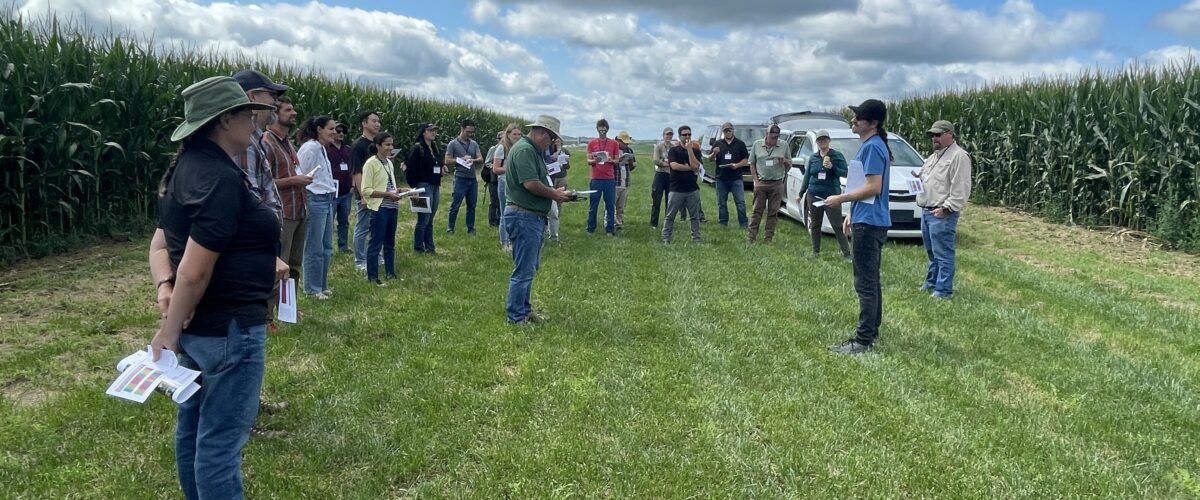
The significance and uniqueness of the Dairy Soil & Water Regeneration (DSWR) project is presented in a newly published article in the Journal of Environmental Quality.
In the overview paper, titled “Integrating soil health and manure practices to advance sustainability for U.S. dairy farms,” 22 researchers from partnering organizations and institutions and other experts around the United States describe the vision behind DSWR, the scientific framework guiding the work and the project’s potential impact.
“The U.S. dairy industry has committed to advancing environmental sustainability by reducing greenhouse gas (GHG) emissions, enhancing water use efficiency and improving water quality,” the authors wrote in describing the dairy community’s 2050 environmental stewardship goals. “Producing feed for dairy cows accounts for about 12% of total GHG emissions from dairy farms and virtually all of the dairy industry’s water use, while most of the potential for water quality impairment on a dairy farm is also associated with growing feed. Thus, improving feed production offers a major opportunity to advance environmental sustainability.”
DSWR is an eight-year project studying soil health and manure management and their effects on GHG reduction, water quality improvement and agronomic factors such as forage yield and quality. The research is taking place on commercial dairies and research farms in key dairy states. The project is a collaboration between Dairy Management Inc., Soil Health Institute, USDA ARS and seven universities to advance progress toward the stewardship goals.
“This project is unique in its scale and scope, where we are testing region-specific management scenarios to understand the impacts to the environment and bottom line for farm operations across the U.S.,” said the article’s primary author, Mara Cloutier, a research scientist and program director at the Soil Health Institute who oversees the organization’s scientific and data management contribution to DSWR. “We are excited to introduce the broader environmental science community to our work.”
The article points out that the existing literature evaluating how using single or multiple soil health management practices under real-world farm conditions in dairy forage systems, such as cover crops, reduced tillage and novel manure products, is limited and insufficient to support changes across the country.
“Current research lacks evaluation of combined management practices with measured, comprehensive environmental outcomes across a sufficiently long (5-plus year) study duration to observe slowly changing variables,” the authors wrote.
The soil health management practices studied in DSWR are tailored to regional forage production systems and are assessed through three research components, referred to as tasks, as presented in the article:
- Task 1. Regional measurements to benchmark soil health and soil carbon stocks on geographically dispersed dairies across the United States.
- Task 2. Field- and plot-scale experiments to quantify GHG emissions, nutrient management, soil carbon storage and water quality/quantity outcomes under advanced soil health management systems and novel manure products.
- Task 3. Biophysical modeling as well as communication to socialize the learnings from the first two components to the dairy community and improve ecosystem and carbon model development.
The authors wrote that while DSWR focuses on the feed production component of dairy farms, it connects more broadly to the industry’s stewardship goals. For example, the article says, improving crop productivity through soil health management could reduce the total land needed for feed, improving feed efficiency and lowering methane emission intensity.
Reza Afshar, vice president – soil, feed and water research at Dairy Management Inc., said that at its core, DSWR is about practical impact for farmers.
“Dairy farmers continuously look for innovative ways to produce healthy and nutritious food while sustaining the environment and their businesses.” Afshar said. “This cutting-edge project provides our farmers with scientific data they can use when making decisions about farming practices that help them meet those goals.”
The Journal of Environmental Quality is published by the American Society of Agronomy, Crop Science Society of America, and Soil Science Society of America. Journal articles cover various aspects of anthropogenic impacts on the environment, including agricultural, terrestrial, atmospheric and aquatic systems, with emphasis on the understanding of underlying processes.