Journal of Soil and Water Conservation publishes DSWR-related paper on soil health and hydrology
November 4, 2026
The Journal of Soil and Water Conservation has published a paper tied to the Dairy Soil & Water Regeneration (DSWR) project reflecting expert perspectives on the interplay between agricultural soil health management and hydrology.
The paper, “Linking soil health, hydrology, and agroecosystem services through expert elicitation,” is based on survey responses from about 400 researchers, conservation professionals, agency staff and others working in North American agricultural systems. They were asked about the perceived impacts of soil health management practices on hydrology and the role of hydrological processes in mediating the impacts of different practices on agroecosystem services.
The paper’s key points:
- Experts identified cover crops, reduced tillage and diverse crop rotations as the most important practices nationwide, but with significant variability in practices by region.
- Soil health management practices were widely perceived to have positive agronomic and environmental impacts.
- Hydrologic and landscape factors, especially soil texture and soil drainage status, had an important influence over whether soil health management practices were able to achieve agroecosystem service goals like improving yield, increasing infiltration or reducing nutrient losses.
- Impacts of soil health management practices on outcomes such as nutrient losses, irrigation requirements and yield were more commonly perceived to be driven by hydrologic changes (such as altered soil water retention and storage) than direct impacts of the practice alone.
“Most field studies analyze connections between soil health and water at a single location, and this elicitation helped us piece together the knowledge from a wide swath of experts spanning the country. Since DSWR is fairly unique in its design, with a consistent data collection and modeling effort across many regions, we can use these cross-regional expert opinions to help us identify what variables and processes to focus on,” said the paper’s lead author, Sam Zipper, an associate scientist at the Kansas Geological Survey and associate professor at the University of Kansas.
“Ultimately, all of this insight can become valuable to farmers who are making practical decisions about regenerative agricultural practices,” Zipper said.
Co-authors of the paper were Meredith T. Niles and Rebecca C. Mitchell from Brown University, Anjan Bhatta from the Kansas Geological Survey, Reza Afshar from Dairy Management Inc. (DMI), DMI consultant Thayer Tomlinson, and Daniel Liptzin and Mara Cloutier from the Soil Health Institute.
Click here to read the full paper.
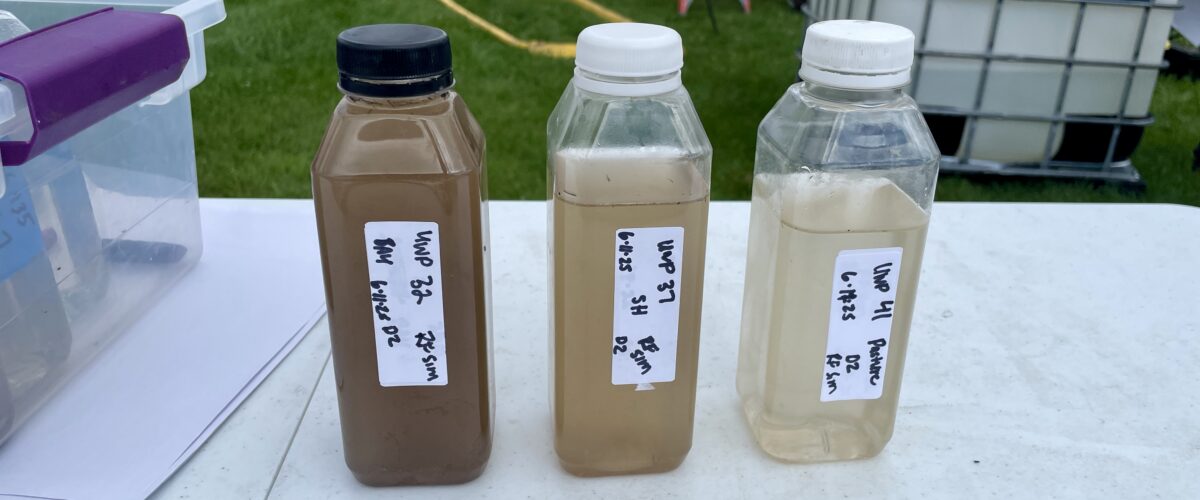
Photo: Water samples collected during simulated rainfall at the University of Wisconsin-Platteville Pioneer Farm show the varying amounts of sediment from runoff in a research plot where conventional field practices are used (left), in a field where soil health management practices are used (center) and in a pasture.