On the Farm: Dedicated team, site quality drive work at UW-Madison research farm
June 24, 2026
The Dairy Soil & Water Regeneration (DSWR) project is capturing data in various dairy regions of the country, representing unique climates, soils and agricultural management practices. The University of Wisconsin-Madison is conducting experiments at the Arlington Agricultural Research Station in south-central Wisconsin. Gregg Sanford, an assistant professor and acting principal investigator for the DSWR project there, shared insights about his team and the nature of working at a research farm.
What is your research focus?
Our work consists of three experiments that center around the agronomic and environmental impacts of two novel manure solids, evaporative and flocculated, in dairy forage production systems.
In one experiment, we are using the manure solids within soil health management systems (cover crops and strip tillage) in large plots to understand the effect on corn silage yield, soil health and greenhouse gas (GHG) emissions. The second experiment uses a field-scale design to determine whether soil moisture and landscape position alter the effects that novel manure solids, cover crops and strip tillage have on corn silage yield, soil health and GHG emissions. Both of these experiments will conclude after this field season.
Lastly, we’ve completed a two-year experiment that aimed to quantify nitrogen credits that can be provided by a single application of the manure solids.
Who are the members of your team and their roles, and how do you work together?
Randy Jackson, a professor in the Department of Plant and Agroecosystem Sciences, and Matt Ruark, a professor in the Department of Soil and Environmental Sciences, serve as co-PIs with me on the project.
As the acting PI, I lead the administrative and experimental oversight aspects of the project.
Adam von Haden, a research scientist, leads the boots-on-the-ground work and much of the data curation and analysis. Adam and I work closely together to ensure that the highest-quality research is conducted. To this end, Adam works tirelessly to ensure, for example, the team has the necessary maps and protocols, optimally functioning equipment and the requisite skills to get the job done, whether it’s measuring trace gas fluxes or collecting soil health samples.
Our agricultural operations manager is Mark Walsh, who implements the cropping systems (planting, tilling and spraying) and maintains our fleet of agricultural equipment (e.g., tractors, planters, plows, sprayers).
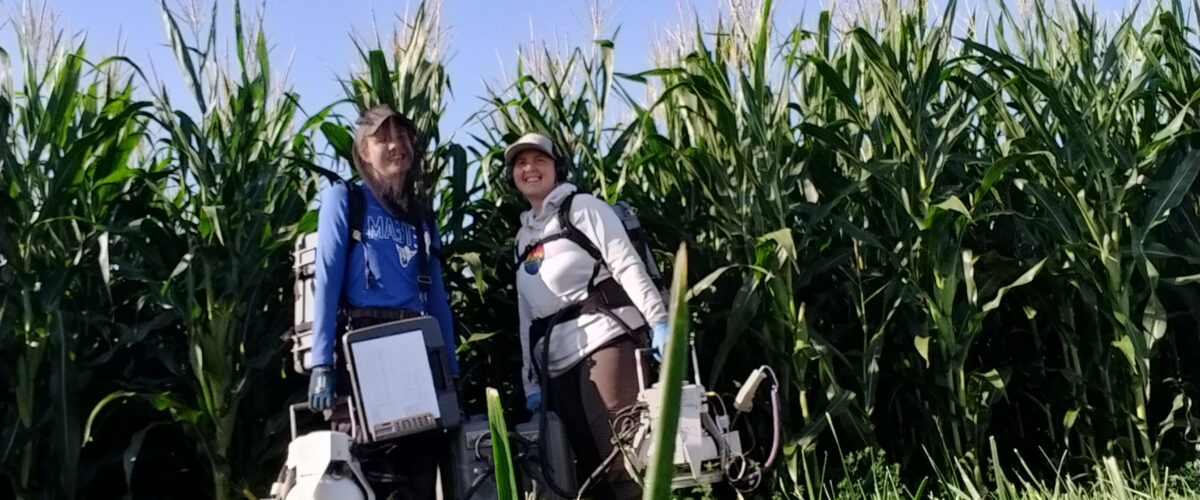
Grace Parrott is a research specialist and Louie Thares is a research technician. Both work in the field collecting soil samples, water infiltration data, trace gases fluxes and end-of-season corn silage yields. They also spend a significant amount of the season processing samples and cleaning up data. They worked closely with Greta Hippensteel, a former research specialist, who recently left the team to be with family in Chicago.
The whole team is awesome! We all communicate and work together well. I am not only impressed by how incredibly hard-working they are, but also by the positive attitude they bring to the work, which can be a grind sometimes.
They are also motivated by the potential to do something better for agriculture. There’s a real, underlying sense of improving farming systems that runs throughout the team. I am so grateful for them!
What is unique about the Arlington station?
As the flagship among 12 University of Wisconsin System ag research stations around the state, Arlington is the largest, with approximately 2,200 acres (plus about 600 rented acres) and is home to the main UW dairy herd.
The breadth of research that occurs at UW’s College of Agricultural & Life Sciences is occurring at Arlington in some way, shape or form, from agronomy, animal and entomology to forestry, horticulture and soils. While each of the 12 stations fills a specific focus for the state (e.g., Hancock and potato research), Arlington’s portfolio is very diverse. We also have the Wisconsin Integrated Cropping Systems Trial. The 37-year-old trial spans conventional, organic, cash grain, dairy forage, perennial bioenergy and livestock grazing enterprises and is one of the most diverse long-term cropping system experiments in the world and includes the longest-running rotational grazing and organic research in Wisconsin.
From a soils standpoint, Arlington is well-suited for DSWR. The fine-textured, prairie-derived soils (called Mollisols) are representative of vast stretches of the central U.S. Corn Belt.
What are the benefits and challenges of doing this work at the research farm rather than a commercial dairy?
The reason we have research stations is primarily to constrain variability as much as possible when asking questions about agricultural systems. We have less control over our research than someone working in a lab setting, where they can control conditions like temperature and humidity, but the station setting gives us the ability to limit sources of “noise” when we’re trying to understand signals in the data. At Arlington, we are also well-resourced from the standpoint of equipment, fertilizer and other agronomic and research needs. We are also surrounded by a legion of experts, from an applied science standpoint, who can help us ask and answer the questions that drive our work.
One challenge of doing this research at the ag station is that it’s a single place. And while our soils are representative of a huge swath of the U.S., they’re also not representative of farms elsewhere in Wisconsin or even just a couple of miles down the road. Soils vary a lot over both short and long distances, so it can be a challenge communicating with farmers about data from a research station when they don’t necessarily see the same conditions on their farms. Another challenge is that a lot of research at stations occurs on a pretty small scale. In an effort to bring a bit of the real world into our research, we work hard to develop and run experiments with larger plots (0.5 acres or more) using equipment that is comparable to that used on commercial farms.
What’s next for your team’s work on the project?
This is our final field season. All of our treatments are up and running, and our early pest control is complete. We will be collecting trace gas fluxes, collecting soil samples and measuring water infiltration, all of which will culminate with the fall harvest.
At the same time, we are cleaning and curating data; it’s time to polish those datasets and tell the stories that have been emerging from the research. I often tell graduate students they should expect to spend as much time analyzing their data as they do collecting it. Running the experiments is a major undertaking, but doing the analysis and data curation is just as big a job. We’re well on our way to analysis and publication of our outcomes; that will be our focus this and next year.
University of Wisconsin-Madison research specialist Grace Parrott (left) and Greta Hippensteel, a research specialist and former team member, at the Arlington Agricultural Research Station.