On the Farm: Water use efficiency is key component of Texas research
February 27, 2026
The Dairy Soil & Water Regeneration (DSWR) project is capturing data in various dairy regions of the country, representing unique climates, soils and agricultural management practices. The Texas A&M AgriLife High Plains Research and Extension Center is conducting research in a semi-arid climate with limited surface water and heavy dependence on the diminishing water in the Ogallala Aquifer. The Texas A&M team shared how their trials are addressing those conditions and provided other insights.
What is your research focus?
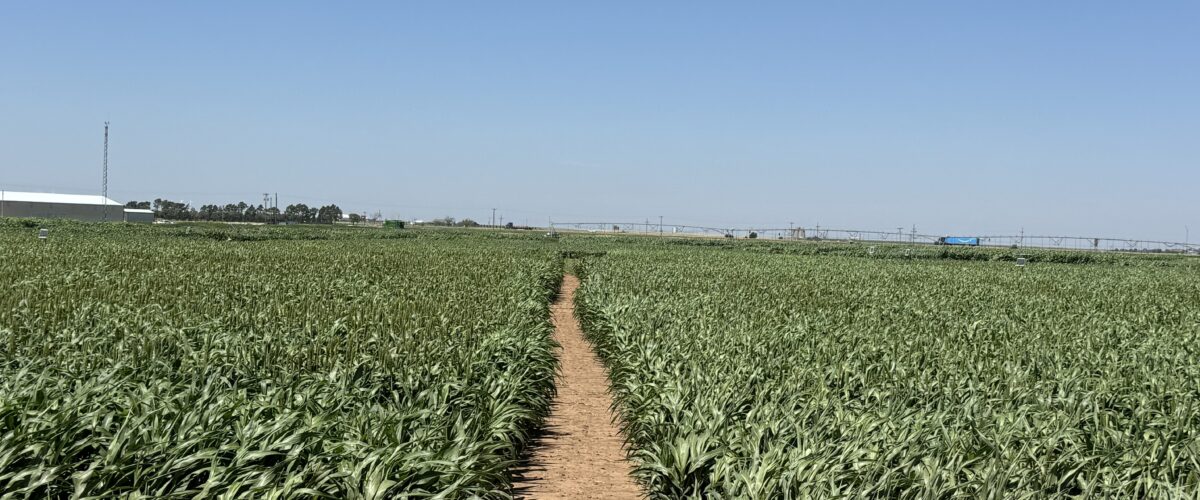
The field experiment at the Texas A&M AgriLife High Plains Research and Extension Center focuses on developing soil health management strategies related to tillage and nutrient management to produce high-quality forage sorghum silage in a limited irrigated system.
In doing so, the experiment compares a conventional tillage system without a cover crop to a reduced-tillage system with wheat as a winter cover crop. For nutrient management, we’re evaluating liquid dairy manure applications (broadcast and injected), evaporative dairy manure solids and commercial nitrogen-based liquid fertilizer. The overall goal is to understand how tillage practices and the wheat cover crop, in combination with dairy manure and mineral nitrogen fertilizer management, impact soil health, greenhouse gas (GHG) emissions, soil moisture, forage sorghum yield and crop water use efficiency in the semi-arid environment of the Texas High Plains.
What is the importance of having Texas A&M AgriLife Research involved in DSWR?
Texas A&M AgriLife High Plains Research is essential to the DSWR project because it provides scientific expertise, regional understanding and applied research capacity needed to address the soil, water and manure management challenges unique to the region. The site is also located in one of the nation’s most important dairy regions, where five of the state’s top dairy-producing counties are hosted: Castro, Deaf Smith, Hartley, Moore and Parmer. The region is known for supporting large, efficient herds averaging around 4,000 cows, abundant silage and forage production, and a rapidly expanding milk processing infrastructure. This combination makes the region a major economic powerhouse with more than $10 billion in annual agricultural impact and rapidly growing dairy receipts.
Its semi-arid climate, limited surface water and heavy dependence on the Ogallala Aquifer also make water use efficiency and regenerative soil management critical for long-term sustainability.
In this context, our team provides rigorous, science-based evaluations of practices such as manure-based nutrient management, reduced tillage and cover crops to improve soil health, increase water infiltration and storage, reduce GHG emissions and sustain forage productivity. The long-term, regionally grounded research, strengthened by strong public-private collaborations, ensures that DSWR advances practical, scalable solutions that protect natural resources while supporting the productivity and resilience of a key dairy region, such as the High Plains.
Who are the members of your team and their roles, and how do you work together?
Our team consists of experts in agricultural engineering, Dr. Brent Auvermann; soil science, Dr. Carolina Brandani; agronomy, Dr. Kevin Heflin and Dr. Jourdan Bell; and animal science, Dr. Myeongseong Lee; as well as dedicated student intern Kylie Deaton and research assistant Zach Hilliard. The overall research planning and coordination tasks are led by Dr. Auvermann as principal investigator, who also guides data synthesis, interpretation, reporting and strategic discussion to ensure alignment with project goals.
Field activities, sampling, environmental monitoring and data collection are conducted under the leadership of Dr. Heflin, Dr. Brandani and Dr. Bell. These activities are implemented by Dr. Lee, Mr. Hillard, and student interns, who ensure rigorous and consistent data acquisition at the field level.
Through this integrated systems-based approach, we effectively connect expertise across disciplines and generate science-backed solutions that support the objectives of DSWR.
The Texas team began trials on a commercial dairy and then moved to a research farm. What are the benefits and challenges of doing this work at the research farm rather than a dairy?
At the initial stage of the project, trials were conducted on a field associated with a commercial dairy to evaluate the DSWR objectives under real-world production conditions. However, balancing the scientific requirements of the project with the operational priorities and management constraints of a working dairy proved challenging. Consequently, the project was transitioned to a research farm.
Conducting trials at a research farm offers several important advantages, including improved control over treatment implementation, more intensive sampling, comprehensive environmental monitoring and appropriate replication. One limitation of the unexpected transition was the limited opportunity to standardize or minimize historical variability in land use prior to manure application. Nevertheless, because such variability commonly exists under practical field conditions, we anticipate that the resulting data will remain representative and broadly applicable to real-world agricultural systems.
What’s next for your work on the project?
After three years of measuring GHG emissions, we have likely missed important daytime fluctuations and short-term emission peaks following manure applications. To address this data gap, we plan to conduct an incubation study using LI-COR smart chambers coupled with gas analyzers. This setup will allow us to collect high-frequency measurements of GHGs throughout the experiment, capturing rapid changes that weekly sampling cannot detect.
The field site has a long history of receiving high manure application rates, which has resulted in elevated phosphorus and nitrogen (N) concentrations throughout the soil profile. Historically, soil nitrogen assessments have focused primarily on nitrate and total N, without accounting for ammonium as a potentially significant nitrogen source. This gap raises an important research question: How much plant-available nitrogen exists within the 0-1.3-meter soil profile, considering nitrate, ammonium and total N and unstable organic N fractions, and how much of this nitrogen is accessible to crops across the rotation?
This next phase of work will help quantify nitrogen cycling dynamics in a system with long-term manure loading, improve estimates of crop-available nitrogen and strengthen our understanding of how excess nutrients affect soil processes over time.