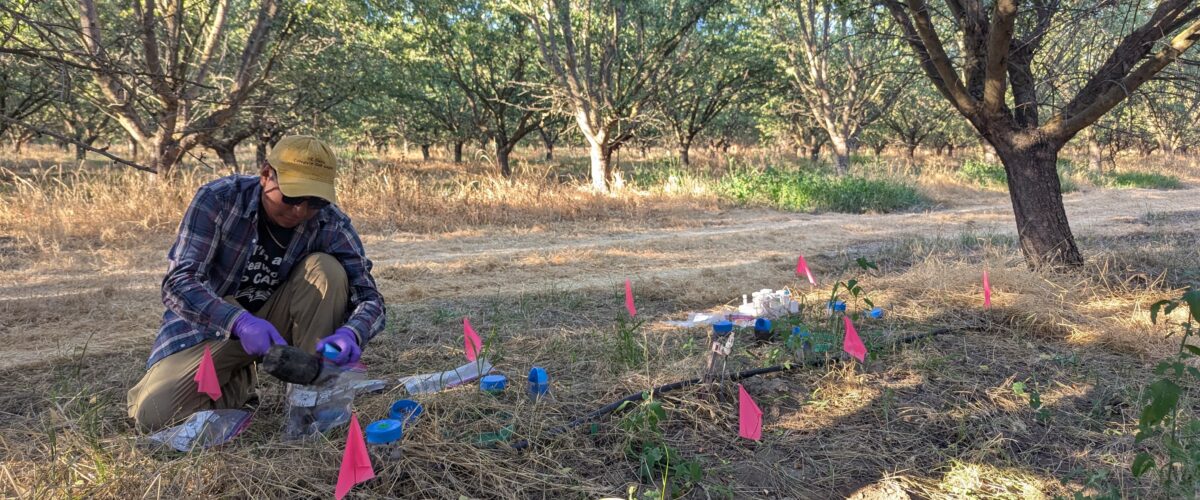
Site Drop-in: UC Davis researchers are deep into data analysis after four-year experiment with manure compost in almond orchard
October 20, 2026
Eight research institutions across the country are participating in the Dairy Soil & Water Regeneration (DSWR) project. Adolfo Coyotl, Ph.D. candidate and graduate researcher at the University of California, Davis, provided an update on research involving a commercial almond orchard, one of two sites in the state that are part of the project.
At the orchard, the UC Davis team is evaluating standard fertigation and the combination of fertigation and composted dairy manure to enhance yields, improve soil health and reduce greenhouse gas emissions.
What is the status of the almond orchard study?
We are deep in our data analysis and writing phase. A monumental amount of data has been produced since the close of our four-year field experiment. We have data spanning from tree trunk circumference and leaf nutrients, soil health metrics such as saturated hydraulic conductivity and soil organic carbon/nitrogen dynamics, to soil gaseous isotopic signals and microbial community data. Lively discussions are being held as data and statistical analyses proceed.
What was the most challenging part of the field research?
The most challenging part was data collection and execution of experiments amid all the work involved in running a commercial almond orchard. The grower and the UC Davis team had to coordinate organic amendment application, fertigation applications, foliar sprays, microsprinkler irrigation, tree pruning, alley mowing, herbicide applications and the installation of pollinator hives. A specific example would be from the last year of the field experiment, when only two fertigation events took place due to climate influences and the advice of the local certified crop adviser. I had planned several experiments that required the usual three fertigation events. In response to this, we used custom built injectors to manually fertigate 240 experimental trees to simulate a third fertigation event during the hottest part of the season.
What has been one of the most interesting findings?
One of the most interesting findings has been the alignment of our isotopic data with reduced nitrous oxide (N2O) emissions. Isotopic data refers to the information collected regarding the weights of atoms in a substance, leaving a unique signature in different environments. The emissions were highest under the conventional fertigation-only treatment, with significantly reduced emissions in the treatment that received the same rate of synthetic nitrogen as the conventional treatment but with additional nitrogen from the dairy manure compost. A suite of isotopic methods was utilized to explore the underlying microbial mechanisms responsible for the N2O reduction. Preliminary data are exciting as they are able to help explain how the compost-plus-fertigation treatment had lower emissions despite having the highest total nitrogen. However, further analysis will paint a more complete picture.
What do you hope both dairy farmers and almond growers take away from this research?
I would like dairy farmers and almond growers to see how industry and environmental goals can be achieved from collaboration while also supporting a sustainable circular nutrient economy. Dairy farms benefit from exporting excess nutrients off-farm and almond growers benefit from the application of these nutrients in a form that provides climate resilient yields, enhanced tree growth and diminished emissions. The geographic overlap between these two industries in California further strengthens this relationship via decreased transportation costs.
Is there an aspect of the project you think could lead to further studies?
Certainly! From my conversations with almond growers interested in implementing organic amendment practices, a common question is, “At what point would decreasing compost or fertigation rates result in no effects observed?” This could inform a future study where varying the rates of each could be investigated to see where the tipping point would be.
I think it would also be very interesting to examine if yield benefits could be seen sooner than the four years it took in our experiment if the inputs were increased. Since microbial mechanisms appear to be the dominant factor in our results, another follow-up experiment could then study whether similar correlations in microbial community composition are found when different kinds of dairy manure products are used.