University of Vermont researchers share insights from on-farm water quality experiments as part of Discovery Farms webinar
April 10, 2026
 University of Vermont (UVM) Extension has been addressing water quality and nutrient management challenges in the state for the past five years through Discovery Acres, a water quality research model affiliated with the multistate Discovery Farms program.
UVM researchers Heather Darby and Claire Benning shared details about their work on March 24 during a webinar that also involved presenters from Discovery Farms programs in Arkansas, Minnesota and Wisconsin.
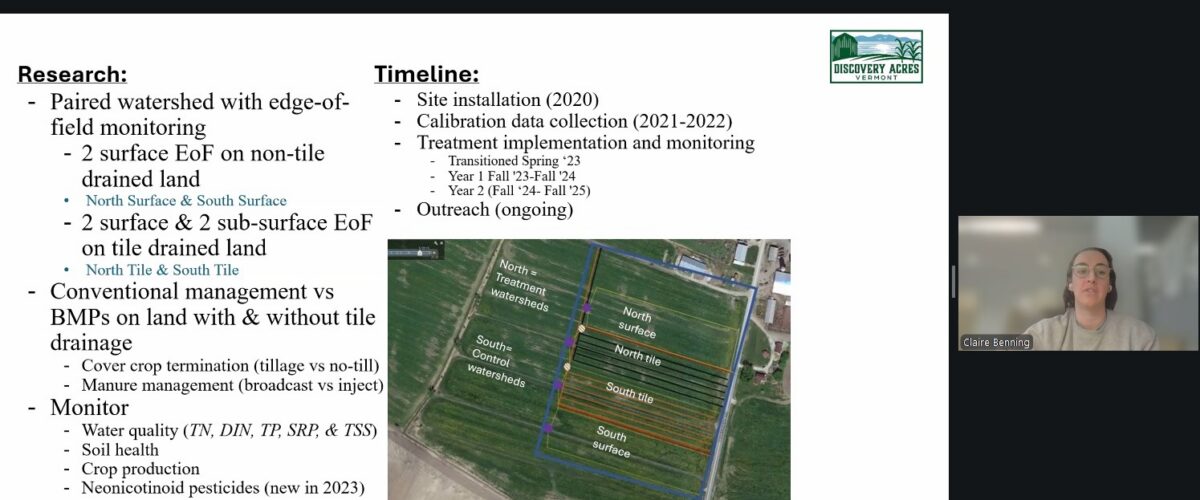
The Discovery Acres site, a leased field on a privately owned dairy farm near St. Albans, Vermont, in the northern part of the Lake Champlain Basin, includes four individual watersheds. Researchers are measuring the effects of tile drainage and soil health management practices on corn silage yields, cover crop growth and water quality.
The location is also a field-scale site in the Dairy Soil & Water Regeneration (DSWR) project where soil health and other parameters are being intensively monitored to complement the water quality and other data collected as part of Discovery Farms. Joshua Faulkner, research associate professor at UVM, is the principal investigator for the university’s work in DSWR, which is an eight-year multistate project studying soil health and manure management practices and their effects on greenhouse gas reduction, water quality improvement and agronomic factors such as forage yield and quality.
The predominant water quality issue in Vermont is excess phosphorus moving into rivers and streams, especially those in the Basin, said Darby, an agronomic and soils specialist. As in other states with significant farmland, agricultural production in Vermont accounts for some of this phosphorus loss. To address the issue, state regulations require various conservation practices for all farms, and the U.S. Environmental Protection Agency has set phosphorus load limits for the Basin.
The Discovery Acres site was started “out of the desire of the farming community to want to do better and to figure out how these practices that they’re being regulated around are impacting water and their farms,” Darby said. “This has been really, really important because it’s the farmers themselves who want the research here.”
Benning, a water quality research specialist and Ph.D. student advised by Faulkner, emphasized the importance of UVM’s research for farmers in a region with poorly drained heavy clay soils where extremely wet conditions are becoming more common.
“This increased heavy precipitation does increase flooding in our fields and decreases crop establishment and yields, as well as leading to a loss of nutrients through runoff events,” Benning said.
To watch the Discovery Farms webinar, click here. (The Vermont presentation begins at the 34:40-minute mark.)
Learn more about Discovery Acres here: https://www.uvm.edu/extension/nwcrops/discovery-acres