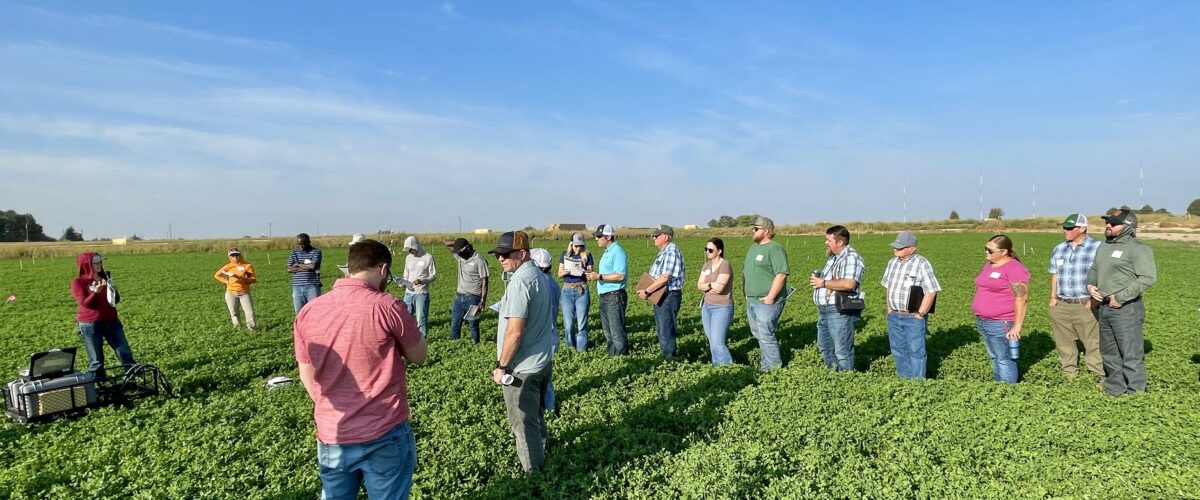
A research farm in a semi-arid region of southern Idaho was the setting for a multifaceted field day held in September featuring the Dairy Soil & Water Regeneration (DSWR) project along with a number of other studies.
The event, held in collaboration with the Idaho Dairymen’s Association and Dairy West at the U.S. Department of Agriculture’s Agricultural Research Service (USDA-ARS) Northwest Irrigation and Soils Research station in Kimberly, drew dairy farmers, consultants, industry partners and conservation group members.
Attendees received a full-picture view of DSWR from Victor Green, director of soil health and crop sustainability at Dairy Management Inc., which initiated the eight-year multistate research project along with the Soil Health Institute (SHI). The project is studying soil health and manure management and their effects on the environment and agronomic factors such as forage yield and quality.
April Leytem, a research soil chemist who led the DSWR work in Kimberly, provided insights into her specific field trials exploring effects of novel manure products — evaporative and flocculated solids — in soils with and without prior manure application in a corn silage-triticale rotation. Leytem and her team also conducted a two-year study evaluating the nitrogen fertilizer replacement value of manure and manure products.
“My team and I are excited to participate in this project because it’s the first time we’ve been able to evaluate some of these novel manure products in our cropping systems,” Leytem said. “Our dairy producers are very interested in this data as more of these technologies are being adopted on farms. And they’re looking to us for help in how to better manage these products and how to use them sustainably.”
The initial stage of DSWR was the creation of a baseline of soil health and soil carbon on farms in major dairy regions across the country — Idaho, New Mexico, New York, Wisconsin and Texas. Idaho is the third largest milk producing state in the U.S., housing approximately 650,000 milk cows and an equal number of young stock, with the majority of these cows located in southern Idaho’s Snake River Valley.
Dan Liptzin, research scientist and program director for SHI, shared the results of the baseline analysis on participating dairies in Idaho with field day participants.
Attendees also heard about four other studies conducted at the site related to phosphorus drawdown, manure priming, deficit irrigation and how dairy feed composition and manure handling affect potential methane losses from manure.
All of the studies at the Kimberly site are conducted in an environment that receives an average of approximately 9 inches of rain each year, with the majority of precipitation occurring in the winter, resulting in the need for irrigation in crop production. In addition to the USDA-ARS, seven universities in key dairy states are conducting DSWR research.
Leytem was pleased with the field day attendance and engagement, especially the presence of local consultants who write dairy farm nutrient management plans as well as planners from the Idaho State Department of Agriculture and several dairy farmers.
“I hope attendees were able to take away some information related to using novel manure products as a fertilizer source as well as the capacity for nutrient uptake of a variety of forage crops, some of which have not typically been used in the region,” she said.
Green was impressed by attendees’ questions and feedback.
“The interest they showed helps to validate the DSWR project. While our research is not solely looking at new manure technologies, they are prominently featured. It is a real accomplishment that April and the Kimberly research station have collected five years of field data with these manure products that are only recently becoming more available.”
Field days can foster beneficial two-way communication, Leytem said.
“These events are an effective way to share information with farmers and allied industries,” she said. “They also provide an opportunity for producers and other attendees to interact with scientists and provide input into the work that we do.”