Vermont researcher highlights GHG and yield results from DSWR in poster presentation at No-Till & Cover Crop Conference
March 2, 2026
A University of Vermont research specialist shared the results from part of her team’s work on the Dairy Soil & Water Regeneration (DSWR) project at the 2026 No-Till & Cover Crop Conference.
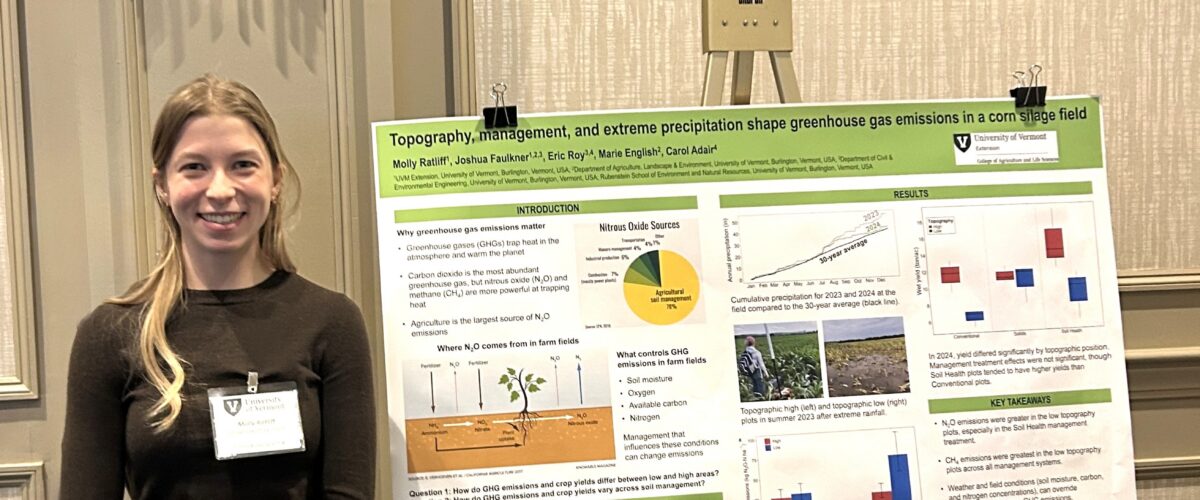
Molly Ratliff presented a research poster at the event, which brought together farmers, crop consultants, agricultural businesses and researchers to discuss soil health, nutrient management, no-till and cover cropping systems. University of Vermont Extension and the Northeast Cover Crops Council hosted the conference on Feb. 19 in South Burlington, Vermont.
The university is one of eight research institutions around the country participating in DSWR, which is being conducted on working dairies and research farms. The eight-year project is studying soil health and manure management practices and their effects on greenhouse gas (GHG) reduction, water quality improvement and agronomic factors such as forage yield and quality.
The Vermont study compares conventional practices, a soil health management system (no-till with winter wheat cover crop and manure injection) and a flocculated solids treatment across low and high locations in fields on two commercial dairies.
Ratliff’s poster highlighted GHG emissions and corn silage yield from the 2024 growing season, which was extremely wet. The results showed that topography strongly influenced both emissions and yield. Low-lying areas of the field generally produced greater nitrous oxide and methane emissions and lower yields, largely due to wetter soils. The soil health treatment exhibited the highest emissions in low areas but achieved the greatest yields in high areas of the field. Overall, yields in soil health plots outperformed those in the conventional plots. The flocculated solids treatment produced the lowest emissions and moderate yields, likely reflecting its lower nitrogen inputs.
Ratliff is continuing to analyze GHG and yield data from the 2025 growing season to better understand how management and landscape position interact over time.